





PRP (platelet-rich plasma) therapy PLATELET RICH PLASMA THERAPY

What is PRP (Platelet Rich Plasma )
therapy?

It is a type of regenerative medicine that draws on our body's
"healing power".

Dr. Sakamoto is also on YouTube! Check out his regenerative medicine channel.

What is PRP (Platelet-Rich Plasma) therapy? A regenerative medicine doctor explains.

What is PRP Therapy?

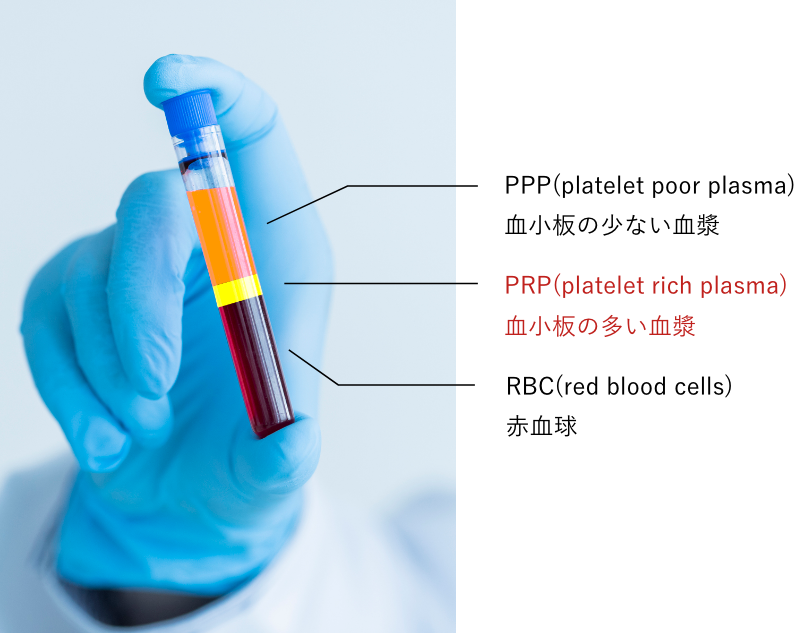
Platelet Rich Plasma (PRP) refers to "plasma that contains a large amount of platelets.

PRP (platelet-rich plasma) is purified by centrifuging one's own blood to produce a concentrated liquid of platelets. The platelets in the blood collect in damaged tissues and cells and release growth factors.

This promotes tissue repair, stimulates new cell growth, and enhances self-healing. This function is used in this treatment to repair damaged tissues and cells and reduce pain.

In PRP (platelet-rich plasma) therapy, highly concentrated PRP is applied to damaged tissues and cells to promote natural healing. In the area where healing is promoted, tissue repair and anti-inflammatory effects are expected to work, thereby reducing pain.
What is PRP Therapy?

In the world of sports, everyone
knows
famous players and athletes
rely on it for their athletic lives
It is a major treatment method

PRP is not considered doping and can be used safely for athletes.

In the United States and Europe, it has been used for several years in the treatment of injuries, mainly by athletes, and it attracted attention and became widely known when it was adopted by Japanese professional athletes such as Shohei Otani and Masahiro Tanaka.

PRP is a major treatment method that everyone in the sports world knows famous athletes and athletes rely on for their athletic lives.

Do you have any of these problems
?

Those suffering from joint pain

  • Dissatisfied with current treatment
  • I can't get rid of pain in my shoulders and knees.
  • I want to get back to sports and work as soon as possible.
  • I want to heal chronic pain.
  • Allergic to drugs and cannot be treated
  • I want a treatment with lasting effects.

Facial Beauty

  • Skin Regeneration Medicine
  • PRP can also be expected to be used for skin regenerative medicine.

Specific examples of diseases for which PRP therapy is indicated

  • Meniscus injury
  • Achilles tendonitis
  • Medial epicondylitis (golfer's elbow)
  • Knee ligament injury
  • Plantar tendonitis
  • Ligamentous wrist injury
  • Ankle ligament injury
  • Osteoarthritis of the knee
  • TFCC injury
  • Osteoarthritis of the hip
  • Frozen shoulder
  • Patellar tendonitis (jumper's knee)
  • Tendovaginitis
  • Rotator cuff tear
  • Osgood-Schlatter disease
  • Separation of the flesh (muscle tear)
  • Impingement syndrome
  • Lateral epicondylitis (tennis elbow)
  • Meniscus injury
  • Achilles tendonitis
  • Knee ligament injury
  • Plantar tendonitis
  • Ankle ligament injury
  • Osteoarthritis of the knee
  • Osteoarthritis of the hip
  • Frozen shoulder
  • Tendovaginitis
  • Rotator cuff tear
  • Separation of the flesh (muscle tear)
  • Impingement syndrome
  • Ligamentous wrist injury
  • TFCC injury
  • Patellar tendonitis (jumper's knee)
  • Osgood-Schlatter disease
  • Lateral epicondylitis (tennis elbow)
  • Medial epicondylitis (golfer's elbow)
Examples of diseases for which PRP therapy is indicated

How PRP Therapy Works

PRP therapy is a treatment using a concentrated solution of platelets extracted from one's own blood.

Platelets are involved in blood coagulation, but they also have a variety of other functions. Specifically, platelets contain high levels of substances called growth factors.

When tissues and cells are damaged, growth factors are released from platelets and serve to repair tissues and cells. Depending on the type of growth factor, they can stimulate collagen and hyaluronic acid production, blood vessel formation, and bone cell activity.

How PRP Therapy Works

Thus, growth factors also promote tissue repair and cell proliferation, which helps to enhance natural healing.

PRP contains three to five times more growth factors than regular blood, and these growth factors promote tissue and cell repair and reduce pain.

PRP contains 3–5 times more growth factors than regular blood

PRP Therapy
Advantages and Disadvantages

Advantages: High safety and low burden on the body

  • Highly safe treatment

    PRP therapy is a very safe treatment. Because PRP is purified from one's own blood, the possibility of side effects such as allergic reactions or rejection is extremely low.

  • Dealing with intractable diseases

    PRP therapy is expected to be effective in treating previously difficult-to-treat conditions by promoting natural healing power to restore or alleviate injuries and chronic pain.

  • Also effective in skin regeneration

    PRP contains many growth factors, which contribute to the repair and regeneration of skin tissue. Therefore, PRP can be accepted as a safe skin care treatment.

  • Less stress on the body

    Unlike surgery, PRP therapy is administered by injection, so treatment is possible on a day trip. In addition, it is a treatment method with very little burden on the body. Outpatient treatment is possible, and you can receive treatment while leading your daily life.

Demerit: Effectiveness varies among individuals.

  • Effects vary from person to person.

    Since PRP is purified from one's own blood, its composition is not constant, and the effect of treatment varies from person to person. The time of appearance, duration, and degree of effectiveness also vary from person to person.

  • Pain and swelling may occur.

    For a few days after PRP treatment, the area where the injection was received may be painful, swollen, hot, and red, which is an inflammatory reaction. Usually, these symptoms are temporary and will gradually diminish.

PRP Therapy Treatment Flow

Treatment is a 3-step process!
Treatment can be done in one day!

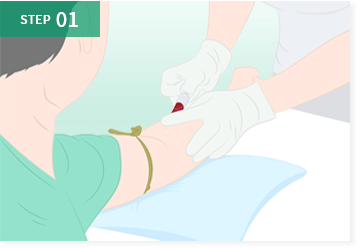
STEP01 Blood collection

Your blood is drawn.

STEP02 The collected blood is centrifuged, and the plasma component is extracted.

The collected blood is centrifuged and
plasma components are extracted.

STEP03 Inject highly concentrated plasma components into the affected area

The high-concentration plasma component is injected into the affected area.

  • Easy to treat

    A blood sample is drawn and plasma components extracted from the blood are simply administered to the affected area. No surgery or hospitalization is required.

  • Safety and Security

    PRP therapy is administered with ingredients extracted from one's own blood, making it a safe treatment that is less likely to cause side effects or allergic reactions.

  • Safety of PRP Therapy

    Since PRP therapy is a treatment using one's own blood, there is no need to worry about side effects like with off-the-shelf drugs, and there is no risk of allergic reactions or rejection. Since the ingredients are made from one's own blood and do not fall under the category of doping, athletes can use PRP therapy with peace of mind.

  • State-of-the-art medical care employed by professional athletes

    PRP therapy is also used to treat injuries of professional athletes because the healing and regeneration speed is two to three times faster than that of general treatment methods.

  • Post-treatment precautions

    PRP therapy is a treatment that intentionally causes inflammation to promote natural healing. Unlike steroid injections, this treatment does not suppress inflammation, and the inflammatory reaction may cause pain for about 3-4 days after treatment.

  • PRP Therapy Precautions

    For the treatment of pain

    • If administered intra-articularly, do not shower or bathe within 24 hours.
    • Please refrain from alcohol and strenuous exercise on that day.
    • If the injected area becomes swollen or red, cool it with your cooling agent.
    • In rare cases, internal bleeding may occur, but it will disappear spontaneously and should be observed for several days. If you are concerned about the symptoms, please come for a medical examination.

    For cosmetic treatments

    • Please refrain from wearing makeup that day. If you do wear makeup, please use a clean puff.
    • You may start washing your face on the same day.
    • Please refrain from using esthetic or facial products for one week.

Characteristics of those who cannot receive PRP therapy
such as

If this applies to you, you may not be able to receive treatment at
.

  • Persons with heart or liver disease
  • Persons with infectious diseases or blood diseases
  • If you are pregnant
  • Other cases in which the physician deems the counseling to be inappropriate

Do you have any questions?

Please feel free to contact us.

Have you heard of regenerative medicine?

The clinic offers
free consultations.

Free Consultation
  • Treatment methods and results
  • Unique stem cell therapy technology
  • Safety and risks
  • Treatment plans and pricing
Chairman Sakamoto
Call for a free consultation 0120-706-313 Toll free/ Office hours: 9:00-18:00

Cost of PRP Therapy

Local and intra-articular injection (1 session)
165,000 yen (Tax included)
Facial beauty (1 session)
165,000 yen (Tax included)

Multiple sessions may be recommended depending on your skin condition.
In such cases, we will offer a multi-treatment plan.

Frequently Asked Questions

How soon will the effects of PRP begin to appear?

The effect varies from person to person, but it takes about a week after administration.
Some patients may feel the effects as early as the day of administration.

How long do the effects last?

The effects of PRP therapy last for several months, so in some cases, such as sports injuries, the damaged area may heal within that period of time.
However, since articular cartilage cannot be regenerated or repaired, symptoms may reappear in progressive diseases such as osteoarthritis.

How many treatments should I receive?

Even a single treatment can have a significant effect.
In some cases, symptoms improve with each treatment, so we suggest the optimal number of treatments depending on the condition of the affected area.

There are several types of PRP therapy, which is the best?

There are several types of PRP therapy, including APS therapy.
Because many of these are based on PRP, which is a concentrated component of the base PRP, the effect is also considered higher than PRP therapy, but originally PRP therapy is a treatment method with large individual differences in effect.

Since the duration and cost of purification varies depending on the treatment method, the best treatment method is the one that best suits your needs.

Can I receive treatment if I am elderly?

The treatment is safe and can be safely performed even by elderly patients.
The time required to purify the PRP is about 30 minutes, so the treatment can be performed easily.

What is the difference between PRP therapy and stem cell therapy?

PRP therapy is a treatment that enhances the natural healing power of the blood by extracting the platelet component of the blood. It is characterized by a shorter purification period than stem cell therapy, and treatment effects tend to appear more quickly.

In comparison, stem cell therapy is characterized by its ability to regenerate and repair damaged tissue. This makes it possible to treat articular cartilage, which is said to be conventionally irreparable. Another feature of stem cell therapy is that it lasts longer than PRP therapy, which has a temporary effect.

Stem cell therapy can also be administered intravenously and is expected to be effective not only locally but also for weak functions throughout the body.

What is APS therapy?

PRP therapy uses platelet-rich plasma from one's own blood. APS therapy (Autologous Protein Solution) is a more highly concentrated form of  PRP.

APS is a next-generation PRP therapy extracted using a specialized APS kit provided by Zimmer Biomet, LLC.

The procedure involves taking 55 ml of blood and placing it in an APS cell separation tube. It is then centrifuged for 15 minutes to produce 6 ml of PRP. This PRP is then placed in an APS concentration tube and centrifuged for 2 minutes to produce 2.5 ml of APS.

What is APS therapy?

APS contains higher concentrations of growth factors and anti-inflammatory proteins than conventional PRP,
providing stronger pain relief and longer-lasting effects.

In fact, a European clinical trial on advanced knee osteoarthritis reported that a single APS treatment reduced pain for up to 24 months.

APS provides stronger analgesia and longer duration of effect than PRP therapy

What is PFC-FD therapy?

PRP is a plasma extracted from blood that contains a large amount of platelet components (growth factors, etc.), while PFC-FD (Platelet-Derived Factor Concentrate Freeze-Dried) is a freeze-dried product made by extracting the growth factors contained in the PRP. Freeze-dried PRP

PFC-FD stands for concentrated platelet-derived growth factors that are freeze-dried. This PFC-FD is an application of PRP and is said to have about twice the amount of growth factors compared to PRP.

The manufacturing process for PFC-FD begins by purifying PRP and extracting only the growth factors from it. When these are activated, a concentrated growth factor, PFC (Platelet-Derived Factor Concentrate), is created.

What is PFC-FD therapy?

The PFC is then processed to be cell-free and freeze-dried to produce PFC-FD.

Compared to PRP, which can be administered on the same day of blood collection, PFC-FD requires three weeks for processing. However, freeze-drying allows for long-term storage up to six months.

At the time of administration, PFC-FD is dissolved in saline to convert it from a powder form back to a liquid.

Production process of PFC-FD
Repair Cell Clinic for Regenerative Medicine TOPtop